
The Do’s and Don’ts of #Hashtagging
Zack Orsborn
Do social media hashtags confuse you? Why do people think they are so necessary? Can they help you or hurt you?
I take a deep dive to better explain the phenomenon known as #hashtags!
Picture this – you’re scrolling through your feed, and all of the sudden, you see a monstrosity equal to this:
#IAmGoingToMakeTheLongestHashtagYouveEverSeen #ForNoApparentReason #ThisWillNotActuallyHelpYouConnectWithPeopleOnSocialMedia
You squint your eyes to read the scrunched-up text. You might accidentally click one only to see that there are no other post results with that same hashtag.
Used correctly, hashtags can be a powerful tool to spread awareness of your brand or to create new trends for a social media campaign.
With hashtags, you can:
- Increase your social post engagement by 21 percent, reports Brandon Gaille.
- Increase your chances of being retweeted by 86 percent, reports Brandon Gaille.
- Start conversations and collect answers into a hashtag stream with services like Rebel Mouse or Tag Board.
But used incorrectly (see hashtags above), you put your readers in a search for meaning and perhaps better eyeglasses. You also create a disorganization for content, making it harder for users to find related content.
The hashtag saga all started with Silicon Valley rockstar, Chris Messina, tweeted out to the world: “How do you feel about using # (pound) for groups. As in #barcamp?”
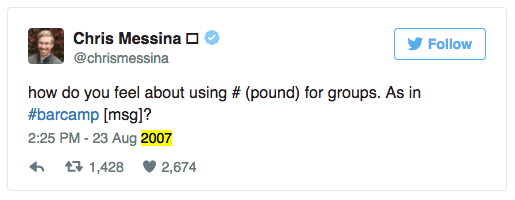
I’m sure Messina had no idea the paradigm shift he had just created. Two years later after Messina’s culture-changing tweet, Twitter started to hyperlink hashtags in tweets, eventually creating the Trending Topics feature.
Then, television stations began broadcasting special hashtags, encouraging viewers to join the conversation online. The stations took it farther by creating custom hashtag tickers to show the flurry of tweets with their special hashtags.
Some companies even began using hashtags for payment options. Event organizers slapped hashtags on announcements to rally everyone together through social media. Hashtags have spread so much in social media culture that people started using them in everyday conversations.
Now that you know a little bit of the history of the hashtag, let’s discuss social media channels and hashtags, your goals for hashtags, and then some Do’s and Don’ts for using #hashtags to promote your brand, event, or yourself.
Social Media Channels & Hashtags
While #hashtags are used across most social media platforms and even in real life conversations, #hashtags resonate more on different channels and less on others.
Facebook – Too many hashtags on Facebook is akin to speaking a different language. Plus, most users don’t click hashtags on Facebook.
Twitter – Twitter is perfect for hashtags, but you only have 140 characters to fit them in!
Instagram – Hashtags on Instagram are engagement gold. Users actively click on hashtags in Instagram, leading to more commenting and post likings.
Different goals for using hashtags
People and brands can have a few different goals for using hashtags.
- Join a conversation or follow a conversation:
- Twitter chats – Organized Twitter chats utilize a certain hashtag so people interested in that subject can follow the conversation easily.
- Learn about your market/your consumers by searching hashtags
- Get noticed by those interested in a specific subject:
- Put your brand out into the world. A current example would be using your brand’s hashtag with #MemphisInMay to reach out-of-town customers.
- Curate content from audience and influencers:
- If you’re stuck with social media writer’s block, you can use your own brand’s hashtag to search for others who have used your hashtag and repost or share their content.
- Learn what others are talking about around specific subjects to inform your own posts or thoughts on social media
- Engage audience
- Brands will often use hashtags to track responses in social media giveaways.
Don’ts:
- Don’t make excessively long hashtags. Example: #WeAreHavingSoMuchFunRightNow
- Don’t use irrelevant hashtags. If you’re creating a hashtag for an event, stick to the keywords or theme of the event.
- Don’t use more than four hashtags for a campaign or event. Three or more hashtags result in a 17 percent drop in engagement.
- Don’t use old, non-trending hashtags like #winning or #fail.
- Don’t use overly-acronymic hashtags. Example: #TGYFBYT17
Now, for the Do’s:
- Use hashtags that are simple and easy to remember. If you are a brand, use hashtags people are more likely to use without prompting.
- Stick with one hashtag. Compared to tweets with three or more hashtags, a tweet with only one hashtag performs 21 percent better engagement-wise, reports Brandon Gaille.
- Use trending hashtags like #tbt or #fbf. Here are even more trending hashtags to use, via Short Stack.
- Make your hashtag punchy and clever so users will want to use it in their posts.
- Make sure another brand or event isn’t using a hashtag you’ve selected. You don’t want to mess up your content curation.
- Use your hashtags on Friday, Saturday, and Sunday. Click-through rates are much higher on those days.
Now, it’s up to you to create the perfect hashtag. Get out a notebook and start writing down the keywords to describe your brand, social media campaign, or event. Then, make sure to do your research to see if those hashtags have already been used. You’re one step closer to increasing your engagement on social media!
If you need help with finding the perfect hashtag or want to boost your social media marketing, Morris Marketing Group would love to help. Give us a call at (901) 425-3770!